Core vs ChatGPT + your editor
Stop the copy-paste loop. Get back to writing.
Pairing ChatGPT with an editor works — but the session becomes copy, paste, re-explain, paste back. Every chapter. Core brings the AI into the manuscript, so it already knows chapter one while you revise chapter thirty.
In brief
A general-purpose AI you reach for anywhere → ChatGPT + your editor. That AI already inside your editor, already knowing your manuscript → Core.
The copy-paste workflow, honestly
"Writing with ChatGPT" usually looks like this in practice:
- Draft today's chapter in Word, Scrivener, or some other editor.
- Open a ChatGPT tab; paste in background — "this is chapter 12 of a novel, here's the premise, here's the last chapter…"
- Paste the passage, ask for a revision.
- Paste the reply back into the editor, clean up the formatting.
- Start from scratch next chapter.
More attention goes into reconstructing context than into writing itself, and it gets worse the deeper into the manuscript you go.
Feature comparison
| Axis | ChatGPT + your editor | Core |
|---|---|---|
| Platform | Web / macOS / Windows / iOS / Android + any editor | macOS 15 Sequoia and later (native) |
| Price | ChatGPT Go $8/mo + whatever editor you use | Pro USD 6.99/mo (14-day free trial) · Max USD 24.99/mo |
| AI model | Latest GPT family | Claude, with the whole project as context |
| Scope of the chat | Any topic — code, data, images, brainstorming | Writing-focused chat with manuscript context |
| Whole-manuscript context | Paste by hand; Plus has context limits | Every file in the project, every time |
| Per-chapter chat | Re-explain from scratch every session | Context is preserved across chapters and sessions |
| Editor experience | Depends on the editor you pair it with | Manuscript, outline, corkboard in one app |
| Research | Web search, Deep Research — citations verified by hand | National library databases — real records only |
| Copy-paste overhead | Constant | None — the AI lives in the editor |
ChatGPT's strengths and weaknesses
Strengths
- You get the latest OpenAI models the day they ship.
- Broadly useful: ideas, summaries, translation, everything else you might do in a day.
- Multimodal (image, voice, code).
- Keeps whatever editor you already love.
Weaknesses
- The workflow is copy, paste, explain, paste back. That cost compounds across a book.
- Context limits mean you can't hold a whole manuscript at once — you re-explain every session.
- Conversations fragment. Each chapter starts from zero.
- Citations drift. Books that sound real may not exist. You verify by hand.
- Typography lives in your editor — ChatGPT doesn't know what it is.
Asking the AI about multiple chapters
Core in action
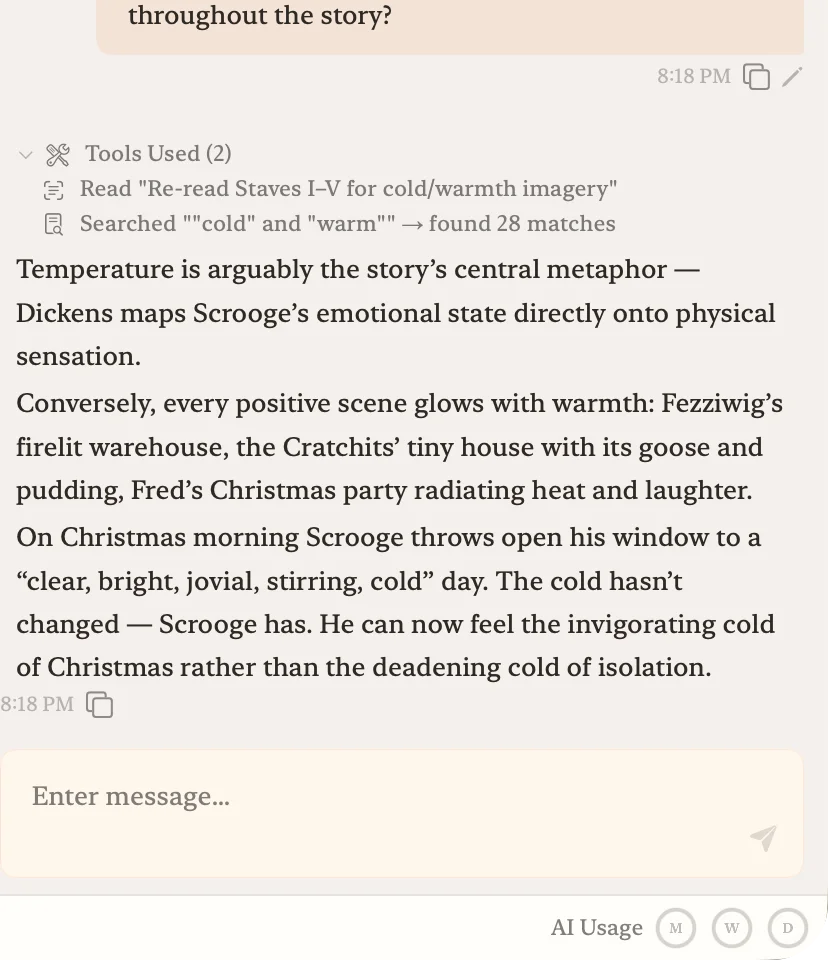
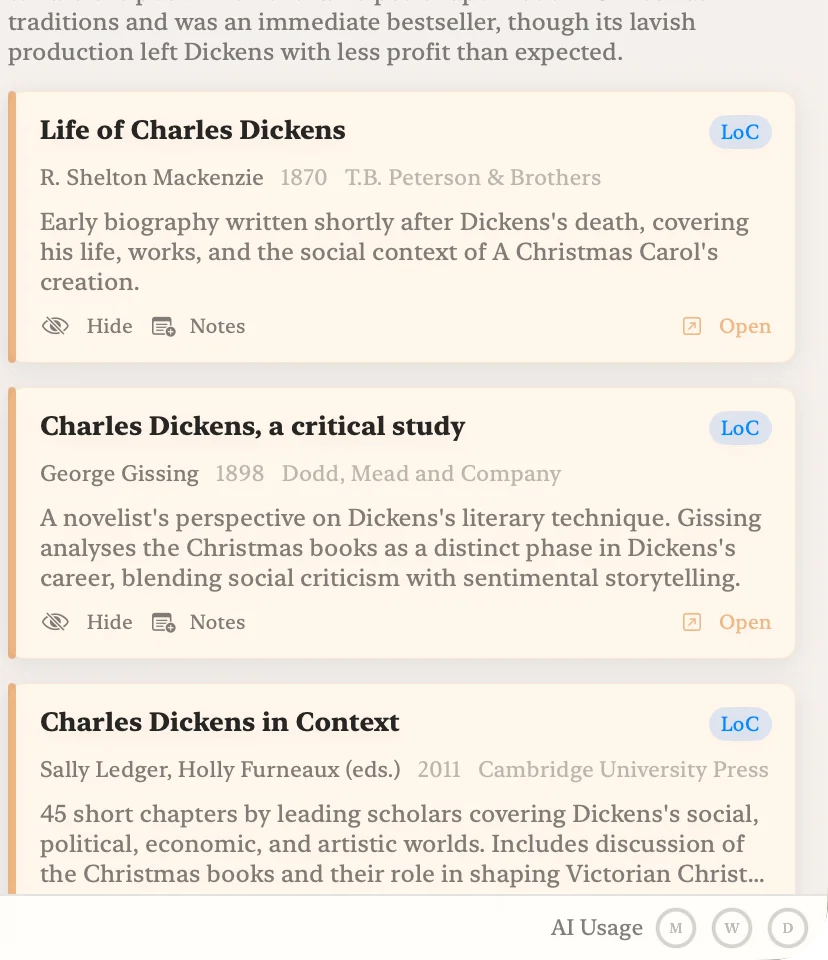
Context and attention
ChatGPT Plus has a finite conversation context (OpenAI help). A 300–400 page manuscript doesn't fit into one session reliably, and referencing chapter 1 while revising chapter 30 usually means cutting, pasting, and explaining — over and over.
Core is built to carry a whole long-form project as the AI's context. The file tree (manuscript, notes, research) is the context. Every question inherits it, which means no preamble, no scaffolding — you ask and it answers with the book in mind.
Citations and hallucination
Large language models can generate plausible but fictitious sources (see OpenAI's explainer). For research-heavy non-fiction, that means every citation from ChatGPT needs human verification before it ends up in the text.
Core's research calls national library and archive database APIs directly, surfacing only records that exist. The AI sees real bibliographic data, not LLM-generated citations.
Pricing side by side
Which one to pick
Who ChatGPT + your editor fits best
Writers who love their current editor and use ChatGPT broadly — not just for writing, but for everything else in a day.
Who Core fits best
Writers who want the AI to already know the manuscript, inside the editor, with no paste-in ritual.
You don't have to give up ChatGPT to use Core. ChatGPT for general work, Core for the book — that pairing is natural.
Frequently asked questions
- Can I write a book using only ChatGPT?
- Not on its own. ChatGPT is a chat interface, so you still need an editor — Word, Scrivener, anything — for the manuscript. Plus-tier context limits make holding a whole book in one session hard; conversations fragment chapter by chapter.
- Does Core replace ChatGPT?
- For writing, yes. Core's AI handles critique, back-and-forth on the manuscript, and revision, with the whole project already loaded. For everything else ChatGPT is good at — recipes, coding, general knowledge — ChatGPT stays useful.
- What do I lose in the ChatGPT-plus-editor loop?
- Time and attention. Copy-paste overhead, re-explaining characters, fragmented conversations, and citations that need verification — each cost is small, but they compound across a book-length project.
Stop shuttling. Get back to writing.
Load your draft into an editor where the AI already sees all of it. Free for 14 days.